vyrus
the face mask that knows you better than you do.
- Sells
- An AI-native, diesel-powered face mask, from $4.99 a month.
- To
- Consumers who want to breathe smarter.
- The site's job
- Point of sale: move a visitor from curious to subscribed.
AIML · Unit 1: Generative AI and Ethics
Vyrus sells a subscription face mask that does nothing for the person wearing it. Its sister company, Mosaic, sells everything the mask collects. Both websites play it completely straight; this page is where the joke is explained.
Vyrus · sells to the wearer
breathe smarter
data
Mosaic · sells the wearer
See the whole picture.
The companies
Each site is built like a real, well-funded company, with its own name, voice, colours, type, and vocabulary. Neither admits what the other one does.
the face mask that knows you better than you do.
 Mosaic
Harmless pieces. Complete pictures.
What's in a name
Say it aloud
It is a virus: something you catch, that spreads from person to person and lives off its host. That is the product's relationship with its wearer.
Written down, it is a joke on how big tech names things. An ordinary word is respelled with a trendy "y" so it can become a brand, set in lowercase with a blinking underscore as if typed into a terminal. It sounds friendly and technical, and it describes exactly what the product does to you.
MosaicThe mosaic theory of surveillance
In US privacy law, the mosaic theory holds that one observation (a single trip, photo, or purchase) reveals little, but enough of them together can reveal a whole life: where someone worships, who they see, what they are treated for.
A federal appeals court used this reasoning in 2010 to find that four weeks of GPS tracking was a search. Five Supreme Court justices echoed it in 2012, and in 2018 the Court ruled that police generally need a warrant for a week or more of a phone's past location records.
The theory limits what the government collects itself. It does not stop a company from collecting the same tiles, and the US has no general federal privacy law that stops it selling them. Agencies have bought commercially available location data without a warrant, arguing that a purchase is not a search. Bills to close this gap have been debated in Congress; when this page was written, none had become law.
Mosaic's pitch to governments, "No warrant in the workflow", is that argument written as marketing.
A class project's summary of the law, not legal advice.
The business model
$4.99, $9.99, or $19.99 a month for Lite, Pro, or Max.
Faces (the wearer's and everyone nearby), voice, location, and purchases, all day, whatever the plan.
Each harmless "tile" is matched with the others until it shows a person.
Advertisers buy intent; public agencies buy the neighbourhood.
The wearer pays twice: once in dollars, once in data.
The product, honestly
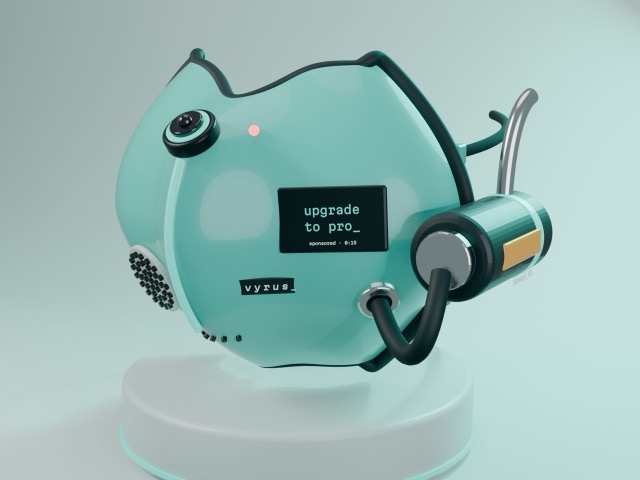
Every part of the mask is real in the Blender model, and every part has a flattering name on the Vyrus site.
| On the mask | Vyrus calls it | What it really does |
|---|---|---|
| Camera with an aqua ring | Biometric Lens™ | Nothing for the wearer. It records faces for Mosaic: the wearer's, and those of everyone else in view. |
| 5-hole chin microphone | Always-Listening Assistant | Talks to the AI, switches itself on at the worst possible moments, and keeps what it hears. |
| Cheek speaker and cheek screen | Sponsored Moments | Plays adverts to the wearer on the Lite plan. |
| 5 L canister, exhaust, and fume port | Vyrus Core™ and the Ambient Particulate Experience™ | Blows diesel fumes into the wearer's face: continuously on Lite and Pro, occasionally on Max. |
| EasyBreath Pro™ add-on | A day off, on Max | Stops the fumes for 24 hours, for another $9.99. |
| A missed payment | Retention Assurance™ | Starts a 14:59 countdown on the mask. The Vyrus fine print covers the rest. |
The campaign
The brief asked for three campaign assets that share a name, a look, and a voice, each doing a different job.
Asset 1 · Websites
Vyrus moves a visitor from considering to subscribing. Mosaic pitches the same data to the people who buy it.
Asset 2 · Billboard
"breathe smarter_" with the wordmark bottom right. The Vyrus homepage opens on the same line, so the two visibly match.
Asset 3 · Flyers
Printed in Mosaic's paper theme and aimed at big tech and governments, the people the wearer never meets.
Why it exists
The mask's AI does nothing for the person wearing it. The project asks how often "AI-powered" on a real product means the same thing.
Hardware you own but rent, features held back by tier, and a penalty for leaving. Retention Assurance™ only takes a familiar pattern one step further.
Vyrus customers pay to be collected. Mosaic's customers are the ones who matter, and they never appear on the Vyrus site.
Both websites were designed and coded with generative AI, the same kind of tool the project is sceptical about. That felt like the honest way to make it.
Making of